Your Advisors Meet With You, but Do They Work as a Team?
Most successful business owners have advisors. They have an attorney they trust. A CPA who knows the numbers. A wealth advisor helping them think about their personal financial future. Some have already established a relationship with an M&A advisor.
On paper, that sounds like a strong exit team.
But there is an important question most owners never ask: do those advisors work as a team?
There is a major difference between having good advisors and having coordinated advisors. Each professional can be excellent at what they do and still give recommendations that create friction somewhere else in your exit plan. Your attorney may recommend a legal structure that makes sense from a risk perspective. Your CPA may see tax consequences that change the economics of that recommendation. Your M&A advisor may be thinking about what a buyer will accept. Your wealth advisor may be looking at what the eventual proceeds need to accomplish for you and your family.
None of them necessarily has the wrong answer. The problem is that they may be answering different questions.
For an EOS run company preparing for an eventual transition, that disconnect can quietly create Value Gaps. Worse, those gaps may remain invisible until a buyer begins due diligence. That is exactly the wrong time to discover them.
Good Advice Can Still Create a Bad Outcome
One of the fundamental ideas behind the Step by Step Exit model is that exit readiness is not something you scramble to create after deciding to sell. It is something you build into the company while you are still running it. That includes your advisory structure.
The SxSE Six1 Framework brings together the specialized advisors required to address the different dimensions of an exit. The goal is not simply to have experts available. The goal is to make sure those experts understand the owner's objectives, understand the business, and coordinate their recommendations.
This matters because the decisions involved in an exit rarely stay inside one professional discipline.
Consider tax planning. Your tax advisor may evaluate your current entity structure and recommend changes intended to improve the tax outcome of a future transaction. But legal structure and tax structure are connected. Financial reporting supports the analysis. The M&A advisor has to understand how different structures affect potential buyers and deal terms. The wealth advisor has to understand what the resulting proceeds mean for the owner's personal financial plan.
The SxSE model explicitly calls for the tax advisor to work in lockstep with the legal, financial, M&A, and wealth advisors. That coordination matters long before a transaction begins.
The Problem With Four Separate Plans
Imagine an owner approaching an exit with four highly competent advisors.
The attorney is minimizing legal exposure. The CPA is minimizing taxes. The M&A advisor is maximizing transaction value and marketability. The wealth advisor is trying to make sure the owner ends up with enough after tax proceeds to fund the next chapter.
Each objective is reasonable. But what happens if nobody is responsible for reconciling them? You can end up with four individually logical strategies that do not produce one coherent exit strategy.
For example, the M&A advisor may believe a particular deal structure will attract the strongest buyer interest. The CPA may identify a substantially different tax result depending on whether the transaction is structured as an asset sale or a stock sale. The attorney may identify contractual or liability considerations that affect what can actually be transferred. Meanwhile, the wealth advisor may discover that the owner's personal financial goals require a different net outcome than everyone has been assuming.
These are not details to sort out after an LOI arrives. They can influence the strategy years before a sale.
The SxSE materials point specifically to the significance of asset versus stock transactions, purchase price allocation, earnouts, seller financing, post closing employment arrangements, timing, and presale restructuring. Each can affect the seller differently, and many cross the boundaries between legal, tax, transaction, and personal financial planning.
If the advisors encounter those questions for the first time during a live transaction, the owner is solving problems under pressure. That is not exit readiness.
Conflicting Advice Can Become a Value Gap
A Value Gap is not always an obvious operational weakness. Sometimes it is the distance between what the owner believes is ready and what a sophisticated buyer will discover is actually ready.
That distinction matters.
An owner may think the company's contracts are fine because the attorney prepared them. But has anyone examined the most important customer and supplier agreements specifically for an ownership transition? Are assignment provisions clear? Are there change of control provisions? Could important agreements terminate or require consent following a transaction?
Those are legal questions, but they can quickly become valuation questions. A buyer assessing uncertainty may discount value, change terms, require additional protections, or decide the opportunity carries too much risk.
The same principle applies to financial information. Your financial reporting might be perfectly adequate for operating the company. But the financial information required to run a business is not necessarily the same information a buyer will expect during due diligence.
The SxSE approach emphasizes accurate, timely, and defensible financial information, along with proactive preparation for the scrutiny a buyer will bring.
When the financial story, legal story, and transaction story do not line up, confidence erodes. And confidence matters in a transaction.
Due Diligence Is Where Misalignment Becomes Visible
Due diligence is essentially a buyer asking your company to prove what you have been saying about it. The buyer will examine financial records, legal documents, contracts, employee information, intellectual property, regulatory matters, and other elements of the business.
The SxSE model encourages owners to think like skeptical buyers before buyers ever arrive. Where are the inconsistencies? What is incomplete? Which assumptions cannot be substantiated? What would trigger another question?
This is where fragmented advisor relationships can become expensive.
Suppose the M&A advisor presents a compelling growth and earnings story, but financial diligence raises questions about the quality or consistency of the underlying reporting. Suppose the financials support the valuation, but the legal review discovers corporate records that were never properly maintained. Suppose the company's major customer relationships look strong, but several important contracts contain provisions that complicate a transfer. Suppose everyone agrees on the headline purchase price, only for the owner to discover late in the process that the tax treatment produces a dramatically different personal outcome.
Each new issue creates another round of questions. Another request. Another meeting. Another negotiation. Another reason for the buyer to become cautious.
The SxSE book makes the point clearly: surprises uncovered by buyers during due diligence can contribute to deals falling apart or prices being renegotiated.
The objective is therefore straightforward. No surprises.
The Cost Is Not Just Time
Owners sometimes view due diligence preparation as an administrative exercise. It is much more than that. Preparation affects leverage.
An Exit Ready business enters a transaction from a position of strength, clarity, and control. Its advisors are coordinated. Its data room is organized. Its financials are defensible. Its legal records are in order. Potential weaknesses have already been identified and addressed.
That preparation allows the owner and the M&A advisor to control the company's story rather than constantly reacting to problems.
The opposite also holds true. When advisors are discovering conflicts in real time, the buyer sees uncertainty. Uncertainty creates perceived risk. Perceived risk can affect valuation and terms. The owner who expected a clean transaction may suddenly find themselves considering additional representations, indemnification, earnouts, seller financing, continued employment, or other conditions intended to reduce the buyer's risk.
That is why exit readiness is about much more than maximizing a valuation number. Deal structure matters. Terms matter. Risk matters. Net proceeds matter. And the owner's life after the transaction matters.
A coordinated advisory team sees the whole picture.
This Is Where EOS Creates an Advantage
For an EOS run company, the solution should not be to create another complicated management system just for advisors. You already have an operating system. Use it.
SxSE is designed to weave exit readiness into the EOS structure rather than operate beside it.
Start with Vision. Your advisors should understand the company's V/TO and the owner's personal exit objectives. Without that context, each advisor is forced to optimize for their own area. An attorney can answer a legal question. A CPA can answer a tax question. But the better question is whether the recommendation supports where the owner and company are actually going.
Next, use Issues. When an advisor identifies a potential tax exposure, contract weakness, financial reporting concern, or transaction risk, it should not disappear into an email thread. Put it on the Issues List. IDS it. Determine what needs to happen and who owns it.
Then use Rocks. Recommendations do not increase enterprise value merely because an advisor made them. They have to be implemented. If the leadership team determines that an issue materially affects exit readiness, turn the solution into a Rock with an owner and a completion date.
Finally, use the Meeting Pulse. The SxSE model recommends establishing a regular cadence with the Six1 advisors, individually or collectively, to review exit readiness initiatives. It also calls for exit readiness measures and Rocks to remain visible inside the company's existing EOS rhythm.
That is the critical shift. Your advisors stop operating as occasional experts outside the business. Their recommendations begin feeding an execution system inside the business.
The Owner Should Not Be the Integration System
There is another hidden risk in fragmented advisory relationships. The owner becomes the translator.
The attorney tells the owner one thing. The CPA tells the owner another. The owner explains both positions to the M&A advisor. Then the owner calls the wealth advisor and tries to explain how everything might affect the personal financial plan.
Now the person who is already responsible for leading the company has also become the information highway connecting every professional involved in the exit.
That is fragile. It also increases owner dependence, which is precisely what an Exit Ready company is trying to reduce.
The Six1 concept is built around coordination. SxSE describes a model in which the advisors are aligned around one operating system rather than assembled piecemeal with no clear plan.
That does not mean every advisor needs to attend every L10. It means there must be a defined rhythm for communication, clear ownership of recommendations, and shared understanding of the objectives.
The owner still owns the relationships. But the owner should not have to personally carry every piece of information between them.
Ask a Better Question at Your Next Advisor Meeting
Instead of asking each advisor, "What do you recommend?" ask: "Who else on our advisory team needs to be involved before we act on this?"
That one question changes the conversation.
If your attorney recommends a structural change, does your CPA need to model the tax impact? Does your M&A advisor need to explain how a buyer might view it? Does your wealth advisor need to model what it means for the owner's personal outcome?
If your M&A advisor recommends preparing for a particular transaction structure, what legal and tax work should happen now rather than later?
If your wealth advisor identifies a required net proceeds number, does the rest of the team understand what enterprise value and transaction structure would be necessary to achieve it?
This is what coordinated planning looks like. Not more advice. Better integration of the advice you already receive.
Turn Advisor Alignment Into an Exit Readiness Discipline
The SxSE model recommends a shared understanding of the V/TO, a regular review cadence, collaborative identification of Rocks, and accountability for implementation.
For an EOS company, that should feel familiar. You are applying the same disciplines that made the operating company stronger to the advisory team helping protect its future value.
Start by asking whether the Right Advisors are in the Right Seats. An excellent generalist may not necessarily have the specialized M&A, tax, or transaction experience required for an exit. SxSE specifically encourages owners to evaluate whether advisors have the expertise and capacity needed for exit focused planning.
Then establish the shared destination. Make sure the advisors understand the business Vision and the owner's exit objectives.
Next, identify dependencies between recommendations. Legal structure affects taxes. Taxes affect net proceeds. Deal structure affects both. Financial reporting affects valuation and diligence. Personal goals influence what a successful transaction actually means.
Finally, turn recommendations into execution. Issues become IDS conversations. Priorities become Rocks. Important measures become Scorecard items. Progress becomes part of the Meeting Pulse.
That is how advice becomes traction.
Your Exit Team Should Operate Like a Team
The danger is not necessarily having a bad attorney, CPA, wealth advisor, or M&A advisor. The danger is having four good advisors working toward four slightly different definitions of success.
Exit readiness requires a broader view. A sophisticated buyer will not examine your company in isolated professional silos. They will look at how the financial, legal, operational, commercial, and leadership pieces fit together.
Your preparation should work the same way.
That is one of the central ideas behind the Six1 Framework. Build the right team before the pressure is on. Give that team shared context. Integrate their recommendations. Use EOS to create accountability and execution.
Because when due diligence begins, you do not want your advisors meeting each other through a buyer's questions. You want them to have anticipated those questions together.
A coordinated advisory team can help uncover Value Gaps while you still have the time and leverage to close them. It can help turn potential surprises into Rocks, unresolved questions into decisions, and fragmented expertise into one coherent exit strategy.
That makes the business easier to diligence. It makes risk easier to manage. And it gives the owner something even more valuable than another opinion.
It gives them clarity, confidence, and control.
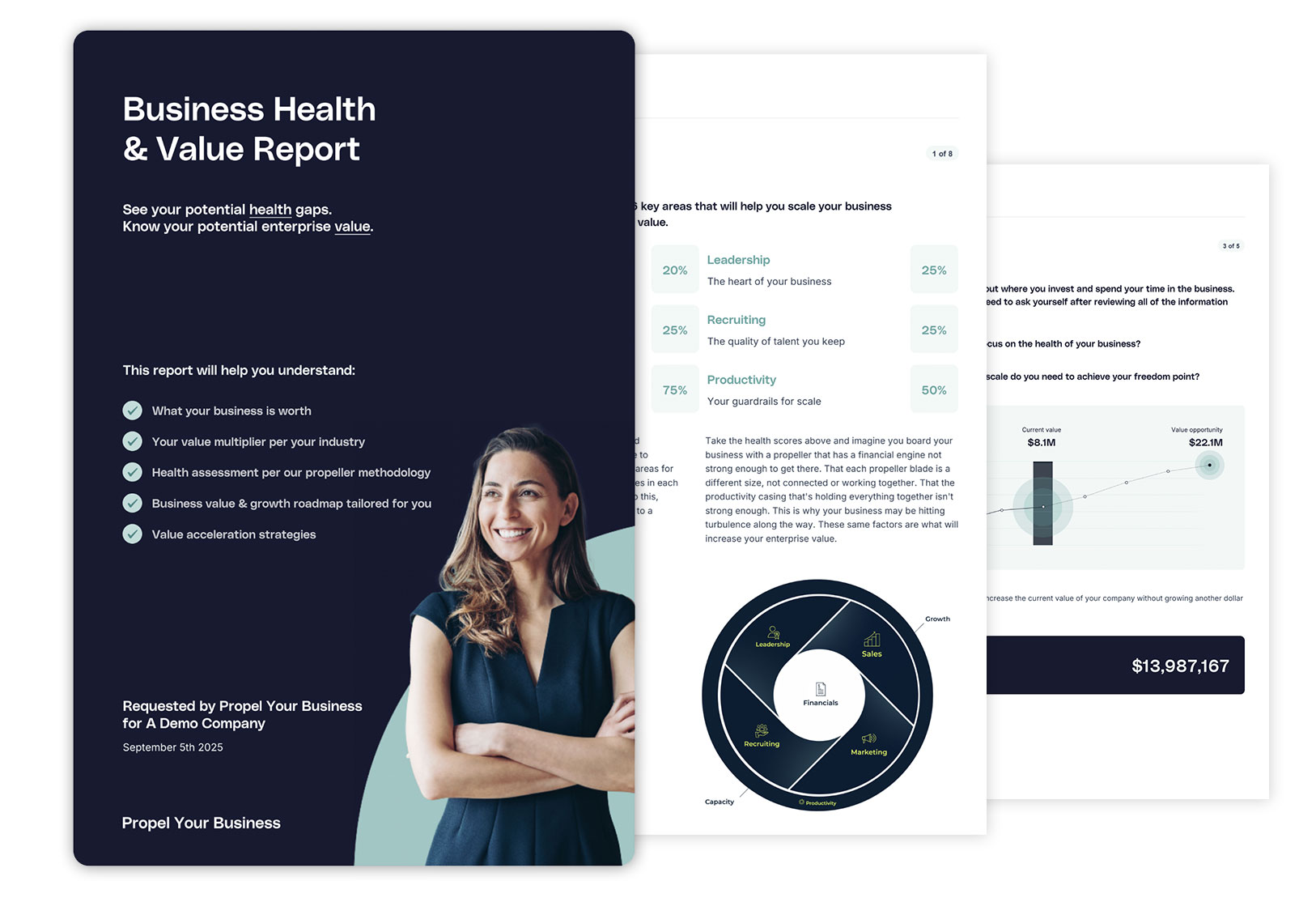
If you are running on EOS and want to see how your business measures up, take the Value Gap Assessment to discover your exit readiness score.