Why Buyers Pay More for Businesses That Are Ready for the Unexpected
If you're running on EOS, you already know what good execution looks like. Every quarter, your leadership team gets clear on the most important priorities, assigns ownership, and drives real results through Rocks. That discipline creates momentum, builds accountability, and helps your business achieve things that actually matter.
But here's an opportunity that even the best EOS companies often miss, and it's worth paying attention to.
Many leadership teams set Rocks that make the business better today without thinking about whether those Rocks make the business more valuable tomorrow. That distinction might sound subtle, but it can be the difference between a good outcome and a great one when the time comes to transition your business.
Here's why it matters so much: when a buyer evaluates your company, they're not buying your history. They're buying confidence in your future. They want evidence that revenue will keep flowing, that leadership will stay effective, that customers will remain loyal, and that operations will hum along regardless of who's sitting in the owner's chair. Businesses that can demonstrate that command higher valuations. It's really that straightforward.
How Buyers Actually Think About Your Business
Most owners evaluate their businesses through the lens of everything they've put into them: the long hours, the hard calls, the relationships built over years, the problems solved through sheer determination. That history is real, and it matters.
But buyers see something different. They see risk.
When a buyer looks at your company, they're asking questions like: What happens if the owner disappears tomorrow? Can the leadership team operate independently? Are customer relationships tied to the company or to one person? Is critical knowledge documented anywhere? Can financial performance continue after the founder steps away?
The answers to those questions often drive valuation more than revenue growth alone. Buyers are essentially asking: how much does this business depend on one person? The less it does, the more they're willing to pay, because confidence in continuity is what they're really purchasing.
The Events That Catch Owners Off Guard
Most business owners assume they'll control when and how they exit. And that's a reasonable expectation to have. But life doesn't always follow the plan.
The 5 Ds, Death, Disability, Divorce, Disagreement, and Distress can force ownership transitions that nobody anticipated. Any one of them can shift your situation from strategic to reactive almost overnight. When businesses aren't prepared, value erodes quickly. Customers get uncertain. Employees get anxious. Leadership gaps surface. Buyers sense the instability and adjust their offers downward.
Buyers know all of this from experience. Which is exactly why they reward businesses that have already addressed these vulnerabilities proactively. Preparation signals stability. Stability signals lower risk. Lower risk leads directly to better valuations and better terms.
The good news? If you're running Quarterly Rocks, you already have the perfect system for building that preparation one quarter at a time.
Rocks That Build Value, Not Just Momentum
Most Rocks fall into one of two camps. The first improves operational performance: launching a new service, improving production efficiency, hiring key people, growing sales activity. These are important and worth doing.
The second category does something more. It creates enterprise value. These Rocks improve transferability, reduce risk, and build the kind of buyer confidence that shows up in your valuation multiple.
The most effective leadership teams do both intentionally. The shift is simple but powerful. Instead of only asking "What do we need to accomplish this quarter?" they also ask "What do we need to accomplish this quarter that will still matter to a buyer three years from now?" That one question changes the entire trajectory.
Here are the five types of Rocks that tend to move the needle most:
Leadership Succession Rocks. One of the biggest red flags for buyers is management dependency, meaning a company where the owner is still the primary decision-maker for everything important. When leadership capability expands beyond the founder, valuation goes up. Rocks in this category might include developing departmental successors, creating leadership scorecards, establishing management accountability structures, or investing in the development of your future executives. These initiatives demonstrate that your company can continue thriving after an ownership change, which is exactly what buyers need to believe.
Tribal Knowledge Transfer Rocks. Most owners carry an enormous amount of value in their heads without fully realizing it. Customer relationships, pricing logic, vendor knowledge, operational shortcuts, strategic context, all of it. When that knowledge lives only with one person, it's a personal asset, not a company asset. Buyers place a real premium on organizations where critical knowledge has been systematically captured and institutionalized. Documenting key processes, building training systems, creating operational playbooks these Rocks reduce dependency and make your business genuinely more transferable.
Due Diligence Readiness Rocks. Here's something that surprises a lot of owners: many deals lose value during due diligence simply because documentation is incomplete or hard to find. Buyers get nervous when they can't easily validate what they're being told. Rocks focused on organizing legal records, updating contracts, cleaning up financial reporting, building a data room, and tightening governance documentation remove that uncertainty. Prepared companies experience smoother transactions, stronger buyer confidence, and fewer unpleasant surprises late in the process.
Customer Diversification Rocks. Customer concentration is one of the most common valuation discounts buyers apply. If one customer represents a large chunk of your revenue, buyers will price in that risk, because they know what happens if that relationship changes after they acquire you. Rocks that reduce concentration among top accounts, expand into new markets, build recurring revenue streams, or diversify your lead sources make your future cash flows more predictable and more attractive.
Owner Independence Rocks. This might be the highest-value category of all. Every step away from owner dependence increases transferability and directly impacts your exit options. These Rocks look like delegating client relationships, removing owner approval bottlenecks, implementing decision-making frameworks, and expanding your leadership team's authority. Each one sends a signal: this business doesn't need its founder to perform. That signal is worth real money.
What Story Do Your Last Eight Quarters Tell?
Here's a thought experiment worth sitting with. If a buyer reviewed your last eight quarters of Rocks, what story would they see?
Would they see a company becoming increasingly independent, scalable, and transferable? Or would they see a company growing in revenue while still depending just as heavily on the owner?
Buyers look for patterns. A consistent history of value-focused Rocks tells a compelling story: leadership is developing, knowledge is being transferred, risks are being reduced, systems are getting stronger. That story creates leverage. And leverage creates value.
A Special Word for Integrators
If you're an Integrator in an EOS company, you're in a uniquely powerful position here. Because you oversee execution across the business, you can make exit readiness part of your operating rhythm rather than a future project that never quite makes it onto the agenda.
Before Rocks get finalized each quarter, it's worth asking: Does this Rock reduce risk? Does it improve transferability? Does it increase buyer confidence? Does it make the business stronger without requiring the owner's involvement? Those questions, asked consistently, transform ordinary execution into long-term value creation in a way that genuinely compounds over time.
Your Business Deserves to Be Ready
Buyers pay more for businesses prepared for unexpected ownership transitions because those businesses are fundamentally less risky. They have stronger leadership, documented systems, transferable knowledge, cleaner financials, and the resilience to perform under new ownership.
The best EOS companies recognize that exit readiness isn't a future event you'll eventually get around to. It's a discipline you build into every quarter, right now, with the same rigor you bring to everything else.
Every Rock is a choice. Some improve the next 90 days. Others improve the next valuation. The companies that command premium value learn to do both, and they start long before they ever need to.
You have the system. You have the cadence. Now let's put it to work for your future.
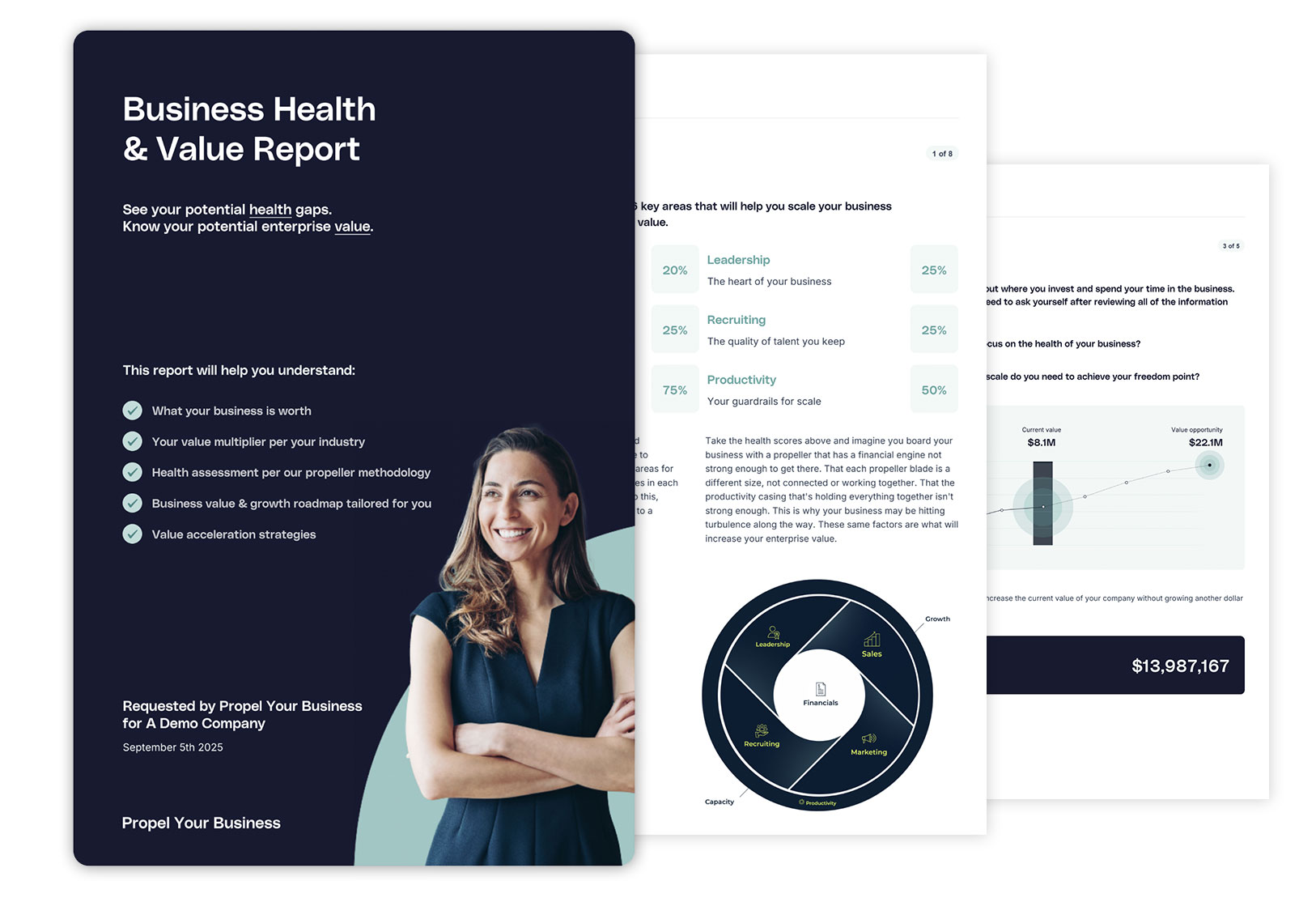
Want to see how your business measures up today? Take the Health & Value Assessment to discover your exit readiness score and find your biggest opportunities.