Which valuation gaps are most commonly solved through focused quarterly Rocks?

EOS companies are known for execution. They set priorities, establish accountability, and create traction. Every 90 days, leadership teams identify their most important Rocks and commit to moving the business forward.
But many EOS companies unintentionally miss one of the greatest opportunities the Rock-setting process has to offer. They focus on operational improvements without asking a critical question: Will this Rock increase the transferable value of the business?
Not all Rocks create equal value. Some improve efficiency for a quarter. Others permanently increase company valuation.
The most valuable EOS companies understand that Quarterly Rocks shouldn't simply help the business run better today. They should systematically eliminate the valuation gaps that buyers, investors, and successors evaluate when determining enterprise value. The companies that command premium valuations are rarely the ones that work the hardest. They're the ones that consistently close risk gaps, reduce dependency, strengthen leadership, and improve transferability over time.
This is where exit readiness and EOS become powerful partners.
The Step by Step Exit model extends the EOS framework by helping leadership teams identify the valuation gaps that matter most and convert them into actionable Quarterly Rocks. Rather than treating exit readiness as a future event, the business becomes stronger, more valuable, and more resilient every quarter.
The Difference Between Operational Rocks and Valuation Rocks
Most Rocks fall into one of two categories.
The first improves operational performance: launching a new software platform, hiring a salesperson, updating equipment, improving customer response times. These projects are valuable, but they don't automatically increase enterprise value.
The second directly improves transferability, scalability, or risk reduction: documenting critical processes, creating a succession plan, diversifying customer concentration, strengthening financial reporting, building a management team capable of operating without the owner. These initiatives create lasting value because they address the concerns buyers evaluate during due diligence.
The goal isn't to eliminate operational Rocks. The goal is to make sure every quarter includes at least one Rock specifically designed to close a valuation gap.
Valuation Gap #1: Owner Dependence
The most common valuation gap in privately held companies is owner dependence.
Many businesses appear healthy until a buyer asks a simple question: "What happens if the owner leaves tomorrow?" If revenue, relationships, decisions, and strategy all flow through one individual, buyers immediately see risk. And that risk translates directly into lower valuation multiples.
EOS companies are uniquely positioned to solve this because Rocks provide a structured mechanism for transferring responsibility. Examples include delegating top customer relationships, transitioning operational approvals, developing department leaders, creating decision-making frameworks, and establishing leadership accountability.
A company that can thrive without the owner becomes significantly more attractive to future buyers.
Valuation Gap #2: Tribal Knowledge
Many organizations unknowingly carry critical information inside the heads of founders, long-term employees, and key managers. The danger becomes apparent when someone leaves. Customer history disappears, vendor relationships weaken, processes break down, and institutional knowledge vanishes.
Buyers view undocumented knowledge as a major risk factor.
Focused Rocks can systematically solve this: creating process documentation, building training systems, recording operational workflows, developing departmental playbooks, and creating internal knowledge repositories. The goal is transforming personal expertise into organizational assets that remain with the company regardless of personnel changes.
Every quarter spent documenting critical knowledge strengthens business value.
Valuation Gap #3: Leadership Bench Strength
Many businesses have talented employees but lack a leadership team capable of independently running the company. Buyers want confidence that growth will continue after acquisition, and that confidence comes from leadership depth.
Strong Rocks in this area might include leadership development programs, successor identification initiatives, department accountability restructuring, executive coaching plans, and cross-functional leadership training.
Businesses with strong leadership benches command greater confidence and often receive stronger offers.
Valuation Gap #4: Financial Transparency
Many companies maintain adequate financial records for tax purposes but lack the reporting sophistication buyers expect. During due diligence, poor financial visibility creates uncertainty, and uncertainty lowers value.
Quarterly Rocks can improve financial readiness by focusing on KPI development, financial dashboard creation, forecasting accuracy, monthly reporting improvements, and profitability analysis by department or customer segment.
The easier it is for a buyer to understand your financial performance, the easier it becomes to justify a premium valuation.
Valuation Gap #5: Customer Concentration
A business dependent on one or two major customers carries substantial risk. Even highly profitable companies experience valuation discounts when revenue concentration becomes excessive.
Rocks that address this might include expanding into new verticals, launching new lead generation systems, developing strategic partnerships, diversifying account portfolios, or entering new geographic markets. These may look like growth initiatives on the surface, but they're equally powerful as valuation drivers because they reduce risk.
Buyers pay premiums for predictable, diversified revenue streams.
Valuation Gap #6: Lack of Documented Systems
EOS already encourages process documentation, but many companies stop before reaching true transferability. A documented process is valuable. A documented process that is consistently followed, measured, and improved is far more valuable.
Rocks that strengthen systems include updating core processes, standardizing onboarding, creating quality control systems, implementing operational scorecards, and building repeatable workflows.
Buyers often view strong systems as evidence that future growth can happen without heroic effort. That scalability increases valuation.
Valuation Gap #7: Exit Team Alignment
One overlooked valuation gap involves the owner's advisory team. Many owners work with attorneys, accountants, wealth advisors, and consultants independently, and those advisors rarely operate from a unified strategy.
The Six1 model was created to solve this by aligning six critical advisors within a coordinated EOS framework. Rocks in this area might include building an advisory team map, conducting strategic advisor reviews, defining succession planning responsibilities, establishing valuation review meetings, and aligning financial, legal, and tax planning initiatives.
Coordination reduces surprises and strengthens readiness long before a transaction occurs.
Making Valuation Part of Quarterly Planning
Most EOS leadership teams ask: "What must we accomplish this quarter?"
Exit-ready companies ask a second question: "What valuation gap will we eliminate this quarter?"
That subtle shift changes everything. Instead of viewing valuation as a future event, it becomes a measurable outcome of quarterly execution. The leadership team improves. The systems improve. The documentation improves. The transferability improves. And valuation follows.
A Final Thought
The highest-value EOS companies rarely achieve premium valuations through a single initiative. They create value quarter after quarter through focused execution. Each Rock closes a risk gap. Each completed project increases transferability. Each quarter makes the business less dependent, more scalable, and more attractive to future buyers.
When owner dependence, tribal knowledge, leadership depth, financial transparency, customer concentration, system documentation, and advisor alignment become part of the quarterly planning conversation, EOS transforms from a business operating system into a valuation growth engine.
The companies that win at exit readiness aren't waiting until they want to sell. They're building value every quarter.
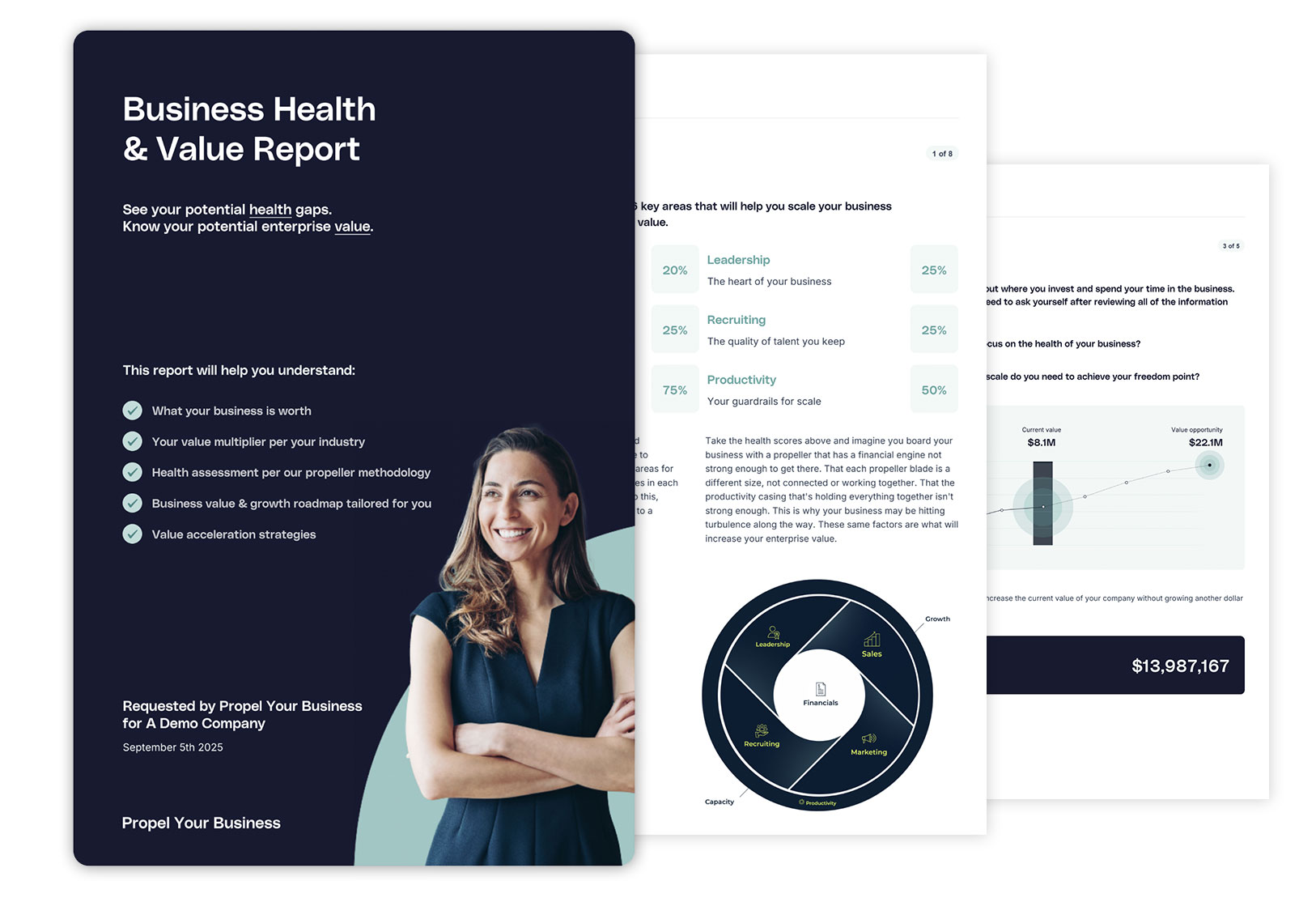
If you're running on EOS and want to see how your business measures up, take the Health & Value Assessment to discover your exit readiness score