Turning Quarterly Rocks into Long-Term Valuation Drivers
Most EOS companies are already familiar with the power of Quarterly Rocks. Rocks create focus. They drive accountability. They help leadership teams gain traction on the priorities that matter most right now.
But many business owners unintentionally limit the value of Rocks because they only use them to solve operational problems. They focus on efficiency. Firefighting. Capacity constraints. Hiring needs. Revenue goals. Process cleanup.
Those things matter.
But if your Rocks are only designed to improve the next quarter, you may be missing one of the greatest strategic opportunities EOS provides:
The ability to systematically increase the transferable value of your business over time. That shift changes everything. Instead of asking: “What do we need to accomplish this quarter?”
Exit-ready companies ask: “What can we accomplish this quarter that permanently increases the value, transferability, and independence of this business?” That is where EOS and exit readiness become incredibly powerful together.
The Difference Between Operational Rocks and Valuation Rocks
Most leadership teams naturally create Rocks around immediate operational needs. Examples include:
Hiring a new sales rep
Improving gross margin
Launching a new marketing campaign
Updating software systems
Increasing production capacity
Solving customer service bottlenecks
These are important. Healthy businesses need operational momentum. But buyers are not simply purchasing operational activity. They are purchasing future certainty.
They want confidence that the company can continue growing without disruption, dependency, or hidden risk. They want predictable cash flow, scalable systems, transferable leadership, and documented execution. That means the highest-value Rocks are the ones that improve:
Transferability
Leadership depth
Decision-making independence
Process consistency
Financial transparency
Succession readiness
Risk reduction
Scalability
Recurring operational reliability
Operational efficiency matters. But transferable enterprise value matters more. The companies that command premium valuations are rarely the companies with the busiest founders. They are the companies with the strongest systems.
EOS Already Provides the Perfect Framework
One of the biggest advantages EOS companies have is structure. The accountability chart already exists. The scorecard already exists. The meeting pulse already exists. Quarterly execution discipline already exists.
The challenge is not building a new system. The challenge is redirecting the system toward long-term value creation. That is exactly where Step by Step Exit becomes powerful for EOS-run businesses. EOS helps you run a great business. SxSE helps you build one that is truly exit-ready.
When you combine EOS discipline with exit-readiness thinking, Quarterly Rocks become more than execution tools. They become strategic valuation drivers.
Buyers Value Predictability More Than Heroics
Many founder-led businesses still rely heavily on the owner. The owner closes the largest deals. The owner solves the biggest issues. The owner carries key customer relationships. The owner approves major decisions. The owner contains tribal knowledge nobody else fully understands. Internally, this often feels normal. Sometimes it even feels efficient. To a buyer, it feels dangerous.
Buyer confidence decreases when too much value is concentrated in one person. That creates what M&A advisors call key-person risk. The more dependent the company is on the founder, the lower the transferable value becomes. This is why some of the most valuable Rocks are not revenue Rocks at all. They are independence Rocks.
Examples include:
Transferring major customer relationships to leadership team members
Documenting core operational processes
Building second-layer leadership accountability
Creating standardized reporting systems
Developing department succession plans
Cross-training operational leaders
Establishing decision-making frameworks
Reducing customer concentration
Improving recurring revenue consistency
Building management scorecards that function without owner oversight
None of these may create immediate revenue spikes. But they dramatically increase buyer confidence. And buyer confidence drives valuation multiples.
The Best Rocks Compound Over Time
One of the biggest misconceptions business owners have about valuation is believing value increases only through revenue growth. Growth matters. But transferable infrastructure often increases valuation faster than raw top-line growth. Why? Because buyers pay premiums for reduced uncertainty.
A company growing quickly but dependent on one owner often receives lower-quality offers than a slightly slower-growing business with strong leadership, clean systems, and predictable execution. Quarterly Rocks become powerful when they compound year after year. A single documented process may not seem transformational. But after twelve quarters of intentional value-building Rocks, the business becomes fundamentally different.
Leadership matures. Processes stabilize. Financial visibility improves. Execution consistency increases. Dependency decreases. Culture strengthens. The organization becomes scalable. Over time, the business transitions from founder-driven to system-driven. That transformation is what sophisticated buyers pay for.
Rocks Should Strengthen the Six Key EOS Components
One of the easiest ways to build valuation-focused Rocks is to evaluate each EOS component through an exit-readiness lens.
Vision
Are your leaders aligned around long-term strategic direction? Valuation-focused Rocks may include:
Creating a three-year succession roadmap
Defining future buyer personas
Clarifying expansion strategy
Identifying strategic growth markets
People
Can the business thrive without the founder? Valuation-focused Rocks may include:
Leadership development plans
Accountability restructuring
Successor identification
Building leadership redundancy
Data
Can buyers clearly understand company performance? Valuation-focused Rocks may include:
Upgrading KPI dashboards
Improving forecasting accuracy
Standardizing financial reporting
Building valuation scorecards
Issues
How quickly does the organization solve problems without escalation? Valuation-focused Rocks may include:
Establishing departmental IDS ownership
Reducing operational bottlenecks
Building root-cause accountability systems
Process
Are operations scalable and transferable? Valuation-focused Rocks may include:
Documenting core processes
Standardizing onboarding systems
Building repeatable client delivery frameworks
Capturing tribal knowledge
Traction
Can the organization consistently execute? Valuation-focused Rocks may include:
Improving leadership accountability
Building quarterly execution scorecards
Increasing cross-functional coordination
Strengthening meeting discipline
When Rocks reinforce these components strategically, the company becomes more attractive not only operationally but financially.
Tribal Knowledge Is a Valuation Killer
One of the largest hidden valuation gaps inside EOS companies is undocumented tribal knowledge. Founders often underestimate how much operational intelligence exists only in conversations, memory, relationships, and instincts. Buyers immediately notice this risk.
If mission-critical knowledge disappears when one person leaves, the business becomes unstable. That instability lowers valuation. The SxSE system emphasizes knowledge transfer because transferable knowledge equals transferable value. This is why Rocks focused on documentation and systemization are so valuable.
Examples include:
Creating operational playbooks
Recording key workflows
Standardizing client onboarding
Building sales process frameworks
Creating financial close procedures
Developing leadership SOPs
Mapping critical vendor relationships
These may not feel exciting compared to sales growth. But buyers consistently reward businesses that are organized, teachable, scalable, and independent.
Quarterly Rocks Should Build Optionality
One of the most important mindset shifts for EOS companies is understanding that exit readiness is not just about selling. It is about optionality. An exit-ready business gives owners leverage. You can sell. You can scale. You can step back. You can transition ownership internally. You can pursue acquisitions. You can bring in private equity. You can remain involved strategically while reducing operational burden.
The earlier you begin building transferable value, the more choices you create later. Quarterly Rocks become the mechanism that builds those choices systematically.
The Leadership Team Must Think Beyond the Quarter
Many companies unintentionally treat Rocks like task lists. But Rocks should reflect strategic direction. The best leadership teams ask deeper questions every quarter:
Does this Rock reduce risk?
Does this Rock increase transferability?
Does this Rock strengthen leadership depth?
Does this Rock improve scalability?
Does this Rock increase predictability?
Does this Rock remove founder dependency?
Does this Rock improve buyer confidence?
If the answer is yes, the Rock likely creates long-term value. This does not mean every Rock must be exit-related. Operational execution still matters.
But the most sophisticated EOS companies intentionally balance short-term operational Rocks with long-term valuation Rocks. That balance creates sustainable enterprise value.
Exit Readiness Is Built One Quarter at a Time
Many owners assume exit preparation starts a year before selling. Premium exits are built years in advance. The strongest valuations come from businesses that consistently improve transferability over time. That is exactly why EOS is such a powerful foundation for exit readiness.
You already have the quarterly cadence. You already have accountability. You already have execution discipline. Now the opportunity is to direct some of that energy toward building a business that is not only successful today, but valuable without you tomorrow.
As the Step by Step Exit framework explains, EOS builds the operational foundation while SxSE layers in the structure needed for transferability, valuation growth, and owner independence. The companies that win long term are not simply the ones growing revenue fastest. They are the ones systematically reducing risk while increasing transferable value every quarter.
That is how Quarterly Rocks become long-term valuation drivers.
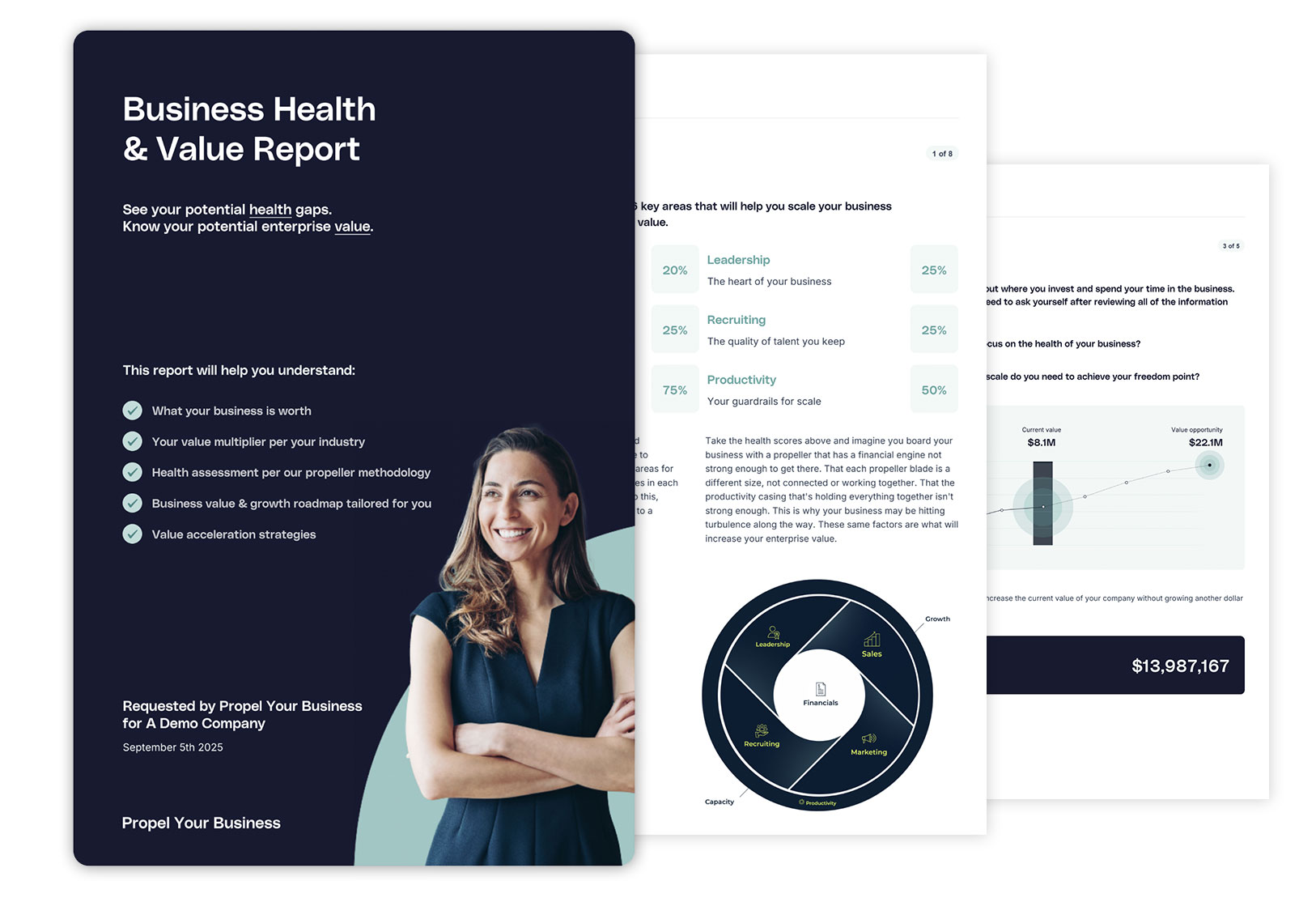
If you’re running on EOS and want to see how your business measures up, take the Health & Value Assessment to discover your exit readiness score.