The Role the Leadership Team Plays in Reducing Owner Dependence
For an EOS company, Quarterly Rocks are designed to answer a practical question: what are the most important things we need to accomplish in the next 90 days?
An exit ready company must ask a second question: if we complete these Rocks, will the business become more valuable and less dependent on the owner?
That distinction matters.
A leadership team can have an excellent quarter. Revenue can grow. Projects can get completed. Scorecards can stay green. The company can hit its targets. Yet the owner can remain at the center of every major customer relationship, strategic decision, critical process, and difficult problem.
From an operating perspective, that business may appear healthy. From an exit readiness perspective, it still carries a significant Value Gap.
Buyers are not simply purchasing what the company accomplished last quarter. They are evaluating whether those results can continue after ownership changes. Heavy owner dependence increases perceived transition risk, while leadership depth, documented processes, scalable operations, and a credible growth strategy strengthen transferable value.
That makes the leadership team central to exit readiness.
The objective is not to remove the owner from the business. It is to build a leadership team capable of assuming greater responsibility while continuing to create growth. That is where Quarterly Rocks become powerful.
Owner Dependence Is More Than an Exit Problem
Many owners assume that reducing dependence on themselves is something to address shortly before selling. That is too late. Owner dependence affects the company long before a transaction begins.
Consider how many important activities may still run through the owner.
The owner approves significant pricing decisions. The owner maintains the largest customer relationships. The owner knows why certain operational processes work the way they do. The owner steps into difficult employee situations. The owner holds the strongest supplier relationships. The owner makes strategic decisions when the leadership team cannot reach agreement. The owner carries years of institutional knowledge that has never been fully transferred.
Individually, none of these situations may look alarming. Collectively, they create a company whose performance is tied to one person.
The SxSE model treats this as a Value Gap because a potential buyer must ask whether the business can keep performing after that person leaves. The framework examines owner dependence, management team strength, succession planning, operational scalability, and the ability of leadership to run and grow the company independently.
There is another reason to address owner dependence now: the same dependence that creates transaction risk also constrains growth. If every major decision eventually reaches the owner, there is a natural ceiling on how quickly the organization can move. Growth requires distributed leadership.
The Leadership Team Is the Bridge
Reducing owner dependence does not mean simply delegating more tasks. Tasks are relatively easy to transfer. Accountability is harder. Decision making is harder still.
A truly exit ready leadership team must develop the ability to operate, solve problems, allocate resources, manage relationships, and pursue growth without waiting for the owner to supply the answer.
This is where the EOS Accountability Chart becomes important. For exit readiness, the question is not simply whether every seat has a name in it. The deeper question is this: would this structure still work if the owner were no longer sitting in the middle of it?
The SxSE framework recommends examining the Accountability Chart through precisely this lens, including whether critical functions currently handled informally by the owner have been identified, and whether leadership seats have the GWC necessary for greater responsibility.
That creates a different leadership development objective. Instead of asking, "What can we take off the owner's plate?" ask, "What capabilities does this leadership team need to develop so the company can keep growing without depending on the owner?"
Those capabilities can then become Quarterly Rocks.
Use Rocks to Transfer Capability, Not Just Work
Suppose an owner personally manages the company's five largest customer relationships.
A weak Rock might be: "Transition key accounts to the sales team." That describes activity, but it does not build organizational capability.
A stronger Rock might be: "Transition primary relationship ownership for the five largest accounts to the sales leader, document account history and relationship strategy in the CRM, and complete joint executive meetings with each customer by quarter end."
Now something important has happened. The relationship is beginning to move from an individual asset to an organizational asset.
The same approach applies throughout the company.
Instead of "Document operations," create a Rock around documenting and transferring ownership of a critical operational process.
Instead of "Develop leadership," create a Rock around transferring a specific category of decisions to a leadership seat with defined authority and measurable outcomes.
Instead of "Create a succession plan," create a Rock around identifying successors for two critical seats and starting a structured development plan.
The SxSE materials recommend converting Value Gaps into measurable Rocks and tracking them weekly through the Level 10 Meeting. Examples include documenting core processes, reducing customer concentration, and developing leadership succession plans.
The objective is not delegation for its own sake. It is increasing transferability.
Do Not Confuse Owner Independence With Owner Disengagement
This is where owners sometimes hesitate. They worry that reducing their involvement will slow growth. The opposite should happen when the transition is managed correctly.
The owner should not disappear from the company. The owner's role should evolve.
Instead of being the person who solves every problem, the owner helps develop people who can solve problems. Instead of maintaining every important relationship, the owner introduces other leaders into those relationships. Instead of making every strategic decision, the owner helps establish frameworks that let the leadership team make increasingly important decisions. Instead of carrying institutional knowledge personally, the owner helps convert that knowledge into processes, systems, and organizational capability.
This creates leverage. The owner gains more capacity to think strategically while the leadership team gains more capacity to execute.
That is why growth and exit readiness should not be treated as competing priorities. The SxSE framework describes them as complementary. Strong leadership, documented processes, reduced owner dependence, scalable operations, and better financial information are valuable to a buyer precisely because they also make the company stronger today.
Build Growth and Transferability Into the Same Rock
A useful discipline during quarterly planning is to examine important Rocks through two lenses.
First: how will this Rock improve the business during the next 90 days?
Second: how will this Rock make the business more transferable over the long term?
Imagine the company wants to enter a new geographic market. The growth objective is obvious. But an exit ready leadership team goes further.
Who owns the expansion? Can the market entry process be repeated without the owner? Are the sales processes documented? Are customer relationships being built with the company rather than exclusively with the founder? Can another leader manage the initiative? Are there Scorecard measurables that show whether the strategy works?
Now the Rock does two jobs. It creates growth today while building a scalable growth engine for tomorrow. That is a valuation driver.
Give Leaders Real Accountability
Owners cannot reduce dependence on themselves while retaining every meaningful decision. Leadership development requires actual authority. That can be uncomfortable.
The owner may be able to make a particular decision faster. The owner may have more experience. The owner may see a problem the leadership team does not yet recognize. But if every imperfect decision causes the owner to take control again, leadership capacity never develops.
A better progression is to transfer authority deliberately. Start with clearly defined decisions. Establish guardrails. Clarify the desired outcome. Allow the leader to make the decision. Review the result. Coach the decision making process. Then expand the scope of authority.
Over time, the organization develops something far more valuable than delegated tasks: independent judgment.
That matters because sophisticated buyers evaluate the leadership team itself. Management depth and the demonstrated ability to operate and grow the business without the owner are explicit exit readiness considerations.
Put Owner Dependence on the Scorecard
What gets measured gets discussed, and what gets discussed consistently has a much better chance of changing.
An EOS company already has the infrastructure for this through the Data Component. The SxSE approach extends that discipline by adding measures that reflect value creation, risk, transferability, and sustainability.
Depending on the business, leadership teams might monitor indicators such as: percentage of major customer relationships owned by nonowner leaders; number of critical processes with documented ownership; number of decisions requiring owner approval; percentage of revenue generated without direct owner involvement; leadership seats with identified successors; and strategic initiatives led independently by members of the leadership team.
These measurements can reveal whether owner dependence is actually declining, or whether everyone is simply talking about delegation.
Use the Meeting Pulse to Protect Long Term Work
One of the biggest challenges with exit readiness is not understanding what needs to happen. It is maintaining focus long enough to make it happen. Urgent operational issues have a way of pushing long term initiatives aside.
EOS companies already have a solution: the Meeting Pulse. SxSE recommends making Exit Readiness part of that existing rhythm rather than building a separate management system. Exit Ready Rocks can be reviewed weekly in the Level 10 Meeting, relevant measurables can appear on the Scorecard, and longer term Mile Markers can be reviewed during quarterly planning.
This keeps leadership development and owner independence from becoming "someday" projects. Every quarter can produce another measurable step: one relationship transferred, one decision category delegated, one core process documented, one successor developed, one owner dependent function moved to the correct seat.
Those changes compound. After one quarter, they may seem small. After eight quarters, the company can look fundamentally different.
The Leadership Team Must Own Exit Readiness Too
Exit readiness cannot remain an owner project. If the owner is the only person thinking about transferability, succession, value gaps, and future buyer risk, the business has created another form of owner dependence.
The leadership team needs to understand why this work matters. That does not mean every employee needs to know an exit timeline or confidential transaction details. It means leaders should understand that building a stronger, more resilient, less owner dependent organization benefits everyone.
SxSE recommends involving the leadership team directly in succession planning, documenting and improving processes, and identifying and strengthening value drivers. That participation creates shared ownership of the company's future.
This changes the conversation. Exit readiness stops sounding like preparation for the owner to leave. It becomes a discipline for building a better company.
Test the Business
Eventually, the owner should test whether the transition is working. Step away, not for an afternoon, but for meaningful periods.
The SxSE materials suggest progressively testing owner independence through one week, two week, and four week absences, and observing what breaks.
The problems that surface are useful. A customer still calls only the owner. A leader hesitates on an important decision. A process exists but nobody follows it. A financial question cannot be answered. A strategic issue sits unresolved until the owner returns.
Those are not reasons to abandon delegation. They are Issues. Identify them. Discuss them. Solve them. Then test again. Each failure reveals another opportunity to make the business stronger.
Quarterly Rocks Should Build a Company That Outlasts the Quarter
EOS creates extraordinary execution discipline. SxSE adds another perspective to that discipline. The goal is not simply to finish more Rocks. The goal is to choose Rocks that compound into long term transferable value.
For the leadership team, that means gradually taking ownership of the capabilities that once depended on the founder: relationships, decisions, processes, people, strategy, and growth.
When that happens, something powerful changes. The owner becomes less essential to daily performance without becoming less valuable strategically. The leadership team becomes more capable. Growth becomes more scalable. The company becomes more resilient.
And a future buyer sees something very different. They do not see a successful owner they need to replace. They see a successful company with a leadership team and operating system capable of continuing what the owner started.
That is what reduces risk. That is what creates optionality. And that is how a Quarterly Rock becomes a long term valuation driver.
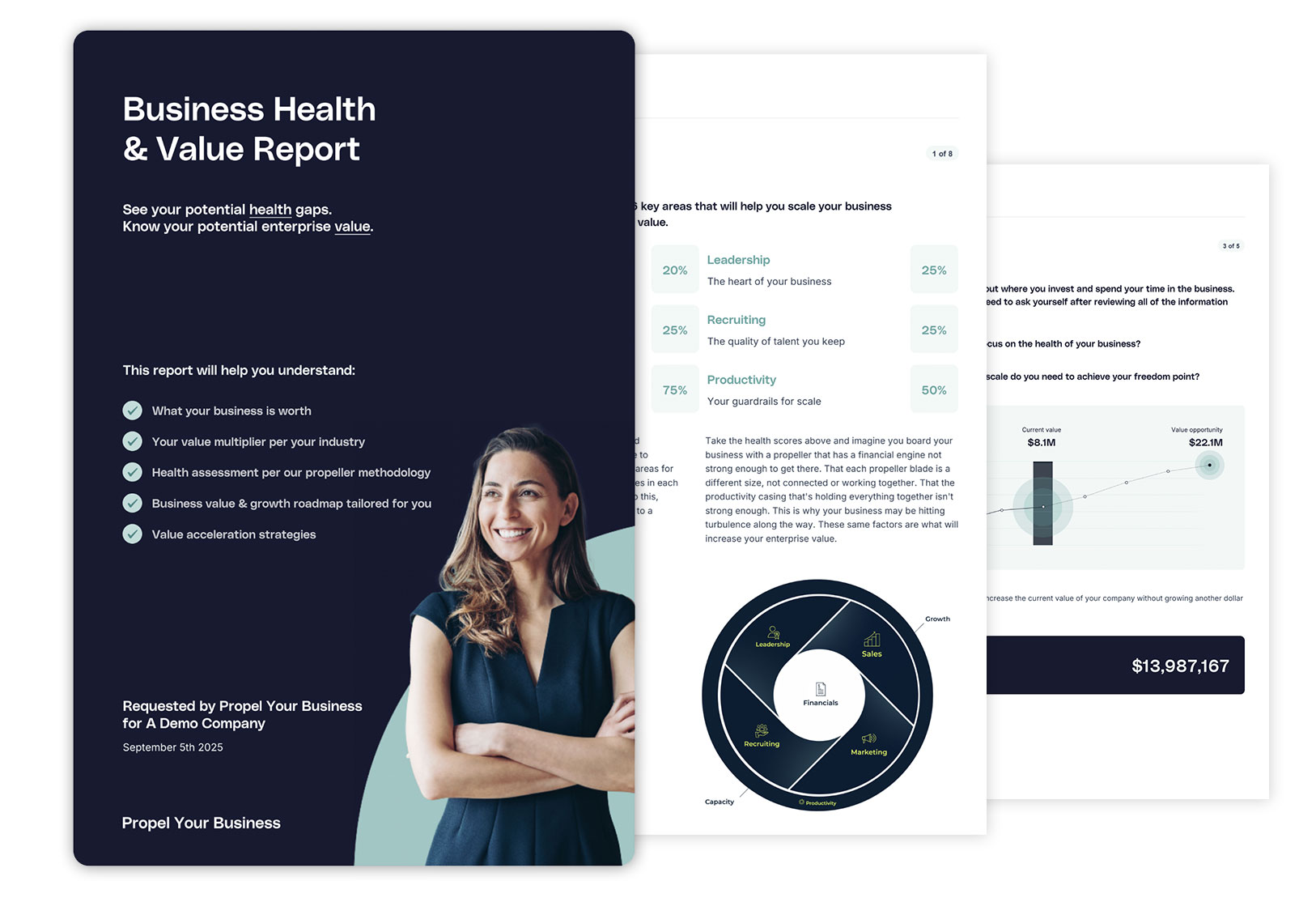
If you are running on EOS and want to see how your business measures up, take the Value Gap Assessment to discover your exit readiness score.