Succession Planning as a Strategic Advantage- Not a Last-Minute Scramble
Why Succession Planning Determines Whether You Exit with Impact or Regret
EOS-run companies often excel at execution, clarity, and accountability—but even the best-run organizations fall dramatically short when succession planning is left until the final stretch before exit. Most founders underestimate how long it takes to build a leadership team capable of running the business without them. They assume a buyer will “figure it out,” or that their #2 will “grow into the role.” Unfortunately, buyers don’t purchase potential—they purchase demonstrated transferability.
And transferability is impossible without succession.
This is why succession planning is not just an HR exercise—it is a valuation lever, a risk-reduction tool, and one of the most strategic moves you can make in the years leading up to your exit.
Today’s interview question gets right to the heart of exit readiness:
What succession-planning milestones must a business hit before it can truly be considered Exit-Ready?
Based on the Step by Step Exit model, the Six1 Framework, and the recurring patterns seen across hundreds of real-world exits, there are seven non-negotiable succession milestones that must be achieved.
The 7 Succession Milestones Required for True Exit Readiness
1. Your Accountability Chart Must Work Without You (Not Just On Paper)
Most EOS Accountability Charts look great visually—but don’t yet represent the actual way the business runs.
To be Exit-Ready, your chart must reflect:
Clear ownership of every function
No “invisible roles” being performed informally by the founder
One leader owning each seat—no shared accountability
A structure that scales without the owner
A buyer isn’t buying your org chart- they’re buying evidence that it performs without you.
If you still serve as:
The tie-breaker on strategic decisions
The largest holder of institutional knowledge
The primary relationship-holder
The fix-it person when things go sideways
…the business is not transferable, and therefore not exit-ready.
Milestone:
A fully defined, fully staffed Accountability Chart with no owner-dependent seats or responsibilities.
2. A Capable Integrator or Second-in-Command Who Truly Runs the Business
In EOS-run companies, the Integrator is the key to transferability.
Buyers see massive risk when:
The Visionary is still too involved in operations
The Integrator is junior, overwhelmed, or actually a department manager in disguise
Decisions bottleneck through the owner
To be ready, your Integrator must be able to:
Lead the L10s
Run the day-to-day business independently
Cascade messages, priorities, and execution
Drive issues to resolution
Manage the leadership team
Operate without Visionary intervention
When the Integrator is strong, buyers relax.
When the Integrator is weak, buyers discount value—often aggressively.
Milestone:
A fully empowered Integrator with demonstrated, measurable success operating without reliance on the owner.
3. Documented, Followed, and Transferrable Processes (Not Tribal Knowledge)
EOS teaches that “documented and followed by all” processes are essential.
But in exit planning, they’re not just essential—
they’re mandatory.
Buyers look for evidence that:
Your business runs systematically
No single person holds critical knowledge
Processes are consistent, scalable, and teachable
A new owner won’t inherit chaos or operational guesswork
Every undocumented process is:
A risk factor
A cost to the buyer
A reason to discount your valuation
Documentation is not about paperwork—it’s about proving your business can operate without you.
Milestone:
Core, revenue-generating, and customer-facing processes fully documented, trained, and followed consistently.
4. Successors Identified for Every Critical Leadership Seat
Succession planning is not just about replacing the founder.
A buyer will ask:
Who runs Sales if your VP leaves?
Who replaces your Ops leader if they burn out or resign?
How deep is your bench?
A company is Exit-Ready only when:
There is a named successor for every key seat
Successors have been trained, tested, and evaluated
Cross-training is complete
The bench is at least 2-deep where possible
Weakness in your bench becomes a weakness in your valuation.
Milestone:
Successors identified, trained, and documented for every critical leadership position.
5. Key Relationships Successfully Transferred Away from the Owner
This is where most exits fail.
If you are still the:
Rainmaker
Chief problem-solver
Exception handler
Primary customer interface
Person who “knows everyone”
…your business is not transferable.
Transfer of relationships should begin 2–3 years before exit.
Buyers analyze:
Who owns the customer relationships?
Are vendor contracts tied to founder goodwill?
Does the Visionary still negotiate major deals?
When the founder holds too many relationships, the business is still founder-centric—not asset-centric.
Milestone:
80–90% of strategic relationships owned by the team—not the founder.
6. A Leadership Team That Makes Decisions Without You
Buyers value a leadership team that:
Solves problems independently
Applies consistent decision-making frameworks
Operates without escalating to the founder
Demonstrates sound judgment
Follows the company’s values and priorities
Decision independence is observable.
You can’t fake it.
If your team still needs:
Signoff
Clarification
Permission
Direction
Oversight
…it signals to buyers that the business is still owner-run, not leadership-run.
Milestone:
A leadership team that consistently demonstrates autonomous decision-making aligned with company strategy.
7. A Fully Operational Succession Plan Tied to Your Exit-Ready Roadmap
Succession planning must not be theoretical.
It must be:
Written
Time-bound
Actively implemented
Paired with performance metrics
Reviewed quarterly within the EOS Meeting Pulse
Integrated with your personal exit timeline
Your succession plan becomes part of your “Exit-Ready Scorecard.”
Buyers want proof of:
Stability
Continuity
Predictability
Low risk
Transferability
When your succession plan is alive—not just a document—your valuation increases.
Milestone:
A formal succession plan aligned to your 1-Year Plan, Quarterly Rocks, and Exit-Ready Roadmap.
CONCLUSION — Succession is Not Optional: It Is Exit Readiness
Succession planning is not a final-year cleanup project.
It is not optional.
It is not an HR initiative.
It is a core pillar of exit readiness—and one of the six SxSE focus areas:
Legacy, Succession, Value Gaps, Due Diligence, Tribal Knowledge, and Advisor Meeting Pulse.
A company with clear succession:
Is more valuable
Has far fewer risks
Survives owner absenteeism
Thrives during due diligence
Commands premium offers
Reduces earn-outs
Gives the owner freedom—before and after exit
If you want to be Exit-Ready—not just sellable—succession is the lever that moves everything else.
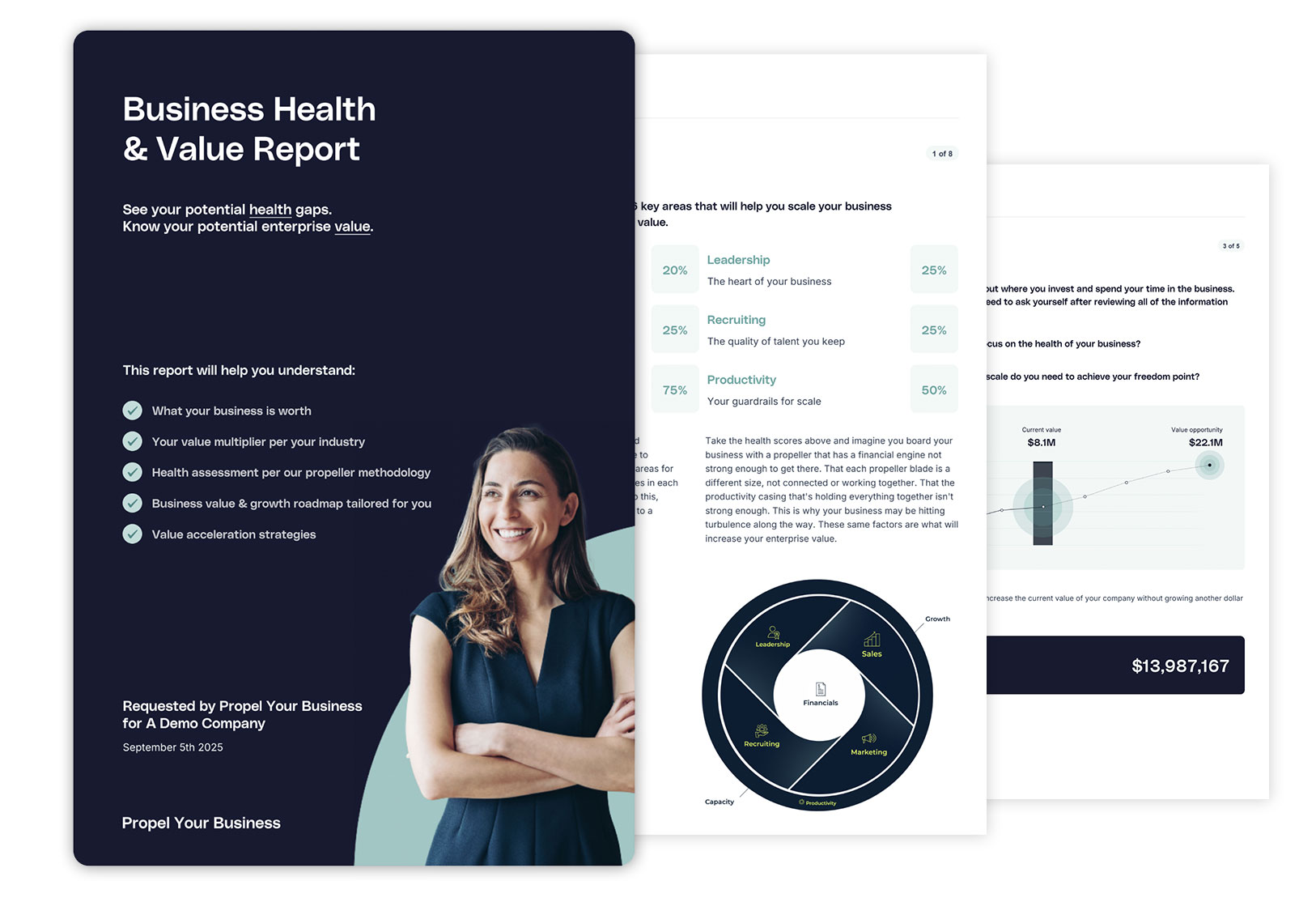
If you’re running on EOS and want to see how your business measures up, take the Health & Value Assessment to discover your exit readiness score.