How Your 90-Day Priorities Today Can Shape the Exit You Deserve Tomorrow
If you're running on EOS, you already know the power of Quarterly Rocks. They create focus when things get noisy. They drive your team to execute when urgency fades. Every 90 days, you make real, measurable progress and that's something to be proud of.
But here's something worth sitting with for a moment: most business owners are unknowingly leaving significant value on the table by treating Rocks purely as operational to-dos rather than what they can also be valuation-building opportunities.
Here's the encouraging truth: the companies that command premium valuations when they sell didn't get there by scrambling to prepare six months before a transaction. They got there because of years of intentional quarterly decisions, a lot like the ones you're already making.
You might be closer to exit-ready than you think. And if you're not quite there yet, you have a clear, repeatable path to get there.
Why Buyers Care About What You're Doing Right Now
One of the biggest surprises for business owners entering a sale process is realizing that due diligence doesn't start when a Letter of Intent gets signed. In reality, buyers are evaluating patterns that stretch back years.
What are they really trying to figure out? One thing: Can this business continue to grow and perform after the current owner leaves?
That answer isn't found in a single financial statement. Buyers look for consistency. They look for evidence that the leadership team has systematically built something that can thrive on its own.
If you're running EOS, you're already building that evidence. Your accountability structures, your documented priorities, your scorecards, your leadership alignment these are exactly what buyers want to see. That's a real head start.
That said, EOS execution alone doesn't automatically equal exit readiness. A business can run beautifully on the system while still carrying risks that would concern a buyer things like owner dependence, undocumented tribal knowledge, or weak succession planning. These issues often stay hidden until due diligence brings them into the light.
The good news? Quarterly Rocks are the perfect vehicle to address them one quarter at a time, long before they ever become a problem.
Not All Rocks Are Created Equal (And That's Okay to Acknowledge)
Let's be honest about something: plenty of Rocks are worth doing but won't move the needle much for a future buyer.
Things like reorganizing internal reporting, updating the office space, or launching an isolated marketing campaign these might be genuinely useful projects. But they rarely change how a buyer evaluates your business.
Value-creation Rocks are different. They directly improve the factors that drive valuation, transferability, and buyer confidence and they keep paying dividends long after the quarter ends. Think things like:
Documenting your core operational processes
Building a management succession plan
Reducing customer concentration
Getting your financial reporting into strong shape
Developing leadership bench strength
Cutting down on owner involvement in day-to-day sales
None of these feel glamorous. But each completed Rock becomes another proof point that your business is becoming more scalable, less risky, and more attractive to buyers. That compounds over time in a very meaningful way.
Here's the Real Secret: Buyers Are Hunting for Risk
Most owners assume buyers are impressed by strengths. And they are but what buyers spend most of their diligence time doing is looking for risk.
They want to find things like key-person dependency, customer concentration, leadership gaps, incomplete documentation, and weak financial controls. They want to find the cracks before they commit.
Here's where strategic Rocks become so powerful. Every quarter is a chance to close one of those cracks:
A Rock focused on process documentation reduces operational risk.
A Rock focused on leadership development reduces succession risk.
A Rock focused on financial reporting reduces transaction risk.
A Rock focused on customer diversification reduces revenue concentration risk.
Individually, these improvements might feel modest. Collectively, they can fundamentally change a buyer's perception of what your business is worth and how much risk they're taking on.
Exit Readiness Isn't a Sprint. It's What You're Already Doing.
Here's the mindset shift that changes everything: exit readiness isn't a massive project you launch six months before you sell. It's the result of consistent execution over time.
Picture two companies with identical revenue and profitability. Company A decides to sell and begins scrambling to prepare. Company B spent three years using Quarterly Rocks to build a leadership succession plan, document core processes, improve reporting, reduce owner dependence, and develop future leaders.
When buyers look at both companies, they see dramatically different risk profiles. Company B almost always gets stronger offers, better terms, and more buyer interest not because they got lucky, but because the work was done.
You don't have to do all of this at once. You just have to do some of it every quarter.
The Rock Categories That Build Real Long-Term Value
Here are the types of Rocks that tend to move the needle most for future buyers:
Succession Rocks — These focus on preparing your leaders to take real ownership of key functions: leadership scorecards, role transition plans, executive development programs. Buyers pay premiums for businesses that can clearly run without one person at the center of everything.
Tribal Knowledge Rocks — A lot of organizations unknowingly carry critical knowledge only in the owner's head. Rocks that document customer relationship histories, build process playbooks, and standardize decision-making frameworks make that knowledge transferable and that's genuinely valuable.
Due Diligence Rocks — Think of these as getting your house in order: cleaner financial reporting, organized data rooms, standardized contracts, better KPI visibility. When diligence eventually begins, preparation becomes a real competitive advantage.
Value Gap Rocks — These address the difference between your current value and your potential value: reducing customer concentration, building recurring revenue, improving gross margins, strengthening management depth. Closing these gaps is one of the most direct ways to increase what your business is worth.
A Simple Question Worth Asking Every Quarter
Here's a quick exercise to try during your next Quarterly Planning session. For each Rock under consideration, ask: "If a buyer reviewed this Rock three years from now, would they care?"
If the answer is no, it may still be a worthwhile project but it's probably not a valuation driver. Intentionally reserving a portion of your Rocks each quarter for value creation, risk reduction, and transferability can have a surprisingly large impact over time.
Just like revenue compounds, exit readiness compounds.
The Real Gift: You're Building Options, Not Just an Exit
Here's the thing that often gets missed in exit planning conversations. The greatest benefit of building an exit-ready business isn't just a better transaction someday. It's optionality.
When your business is exit-ready, you get to choose:
Sell, on your terms and timeline
Scale into something bigger
Step back and let a strong leadership team carry it
Pursue acquisitions
Weather unexpected events from a position of strength
Every owner will eventually exit whether by design or through circumstances beyond their control. Preparing early doesn't just improve your eventual outcome. It gives you freedom and leverage throughout the entire journey.
You're Already Doing the Work. Now Let It Build.
Quarterly Rocks are far more than execution tools. With a little intentionality, they become valuation tools a compounding engine that steadily removes risk, strengthens your team, and increases buyer confidence.
The businesses that command premium valuations aren't the ones that began preparing when they decided to sell. They're the ones that spent years building value one quarter at a time, just like you're positioned to do.
The best due diligence preparation doesn't happen in a conference room six months before closing. It happens every 90 days.
You're already in the cadence. Now let's make it count.
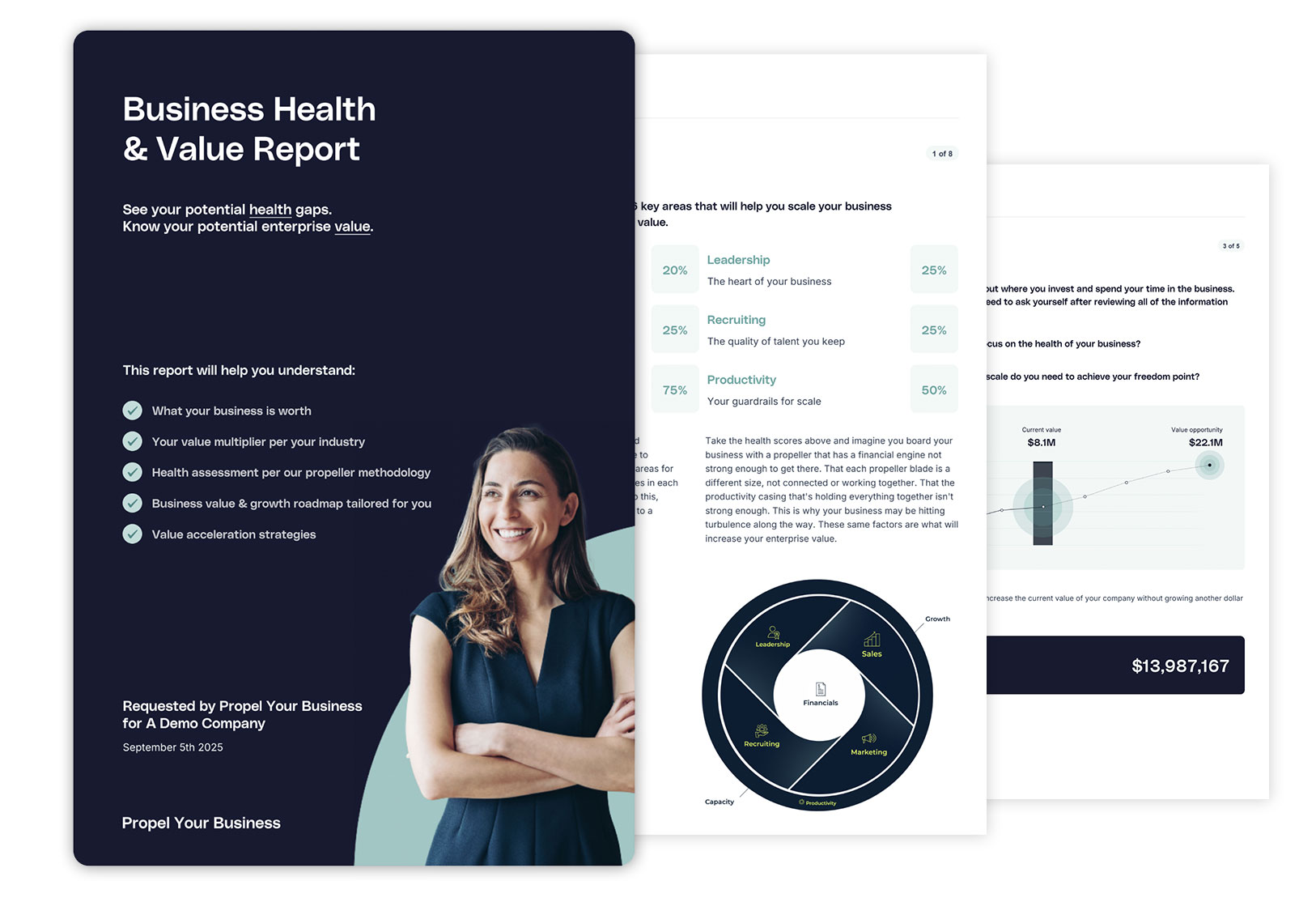
Ready to see where you stand? Take the Health & Value Assessment to discover your exit readiness score and find out exactly where your biggest opportunities are.