How to Prepare Your Leadership Team for Buyer Scrutiny Without Relying on the Owner
Every EOS-run business eventually reaches a defining moment: due diligence. This is where buyers stop listening to the story and start verifying the truth.
And here’s the hard reality most owners don’t see coming:
Buyers are not just evaluating your numbers. They are evaluating your team.
If every answer, every decision, and every explanation flows back to the owner, buyers see risk. Not potential. Not opportunity. Risk.
In fact, one of the biggest value gaps uncovered during due diligence is leadership dependence. Even strong EOS companies can fall into this trap. The business runs well, but only because the owner is still the glue.
At Step by Step Exit, we see this pattern constantly. Businesses that appear healthy on the surface lose leverage in deals because the leadership team is not prepared to stand on its own.
The question is not whether your team is good.
The question is whether your team is ready to be trusted by a buyer.
Why Buyer Scrutiny Targets Your Leadership Team
During due diligence, buyers are asking one core question:
What happens when the owner is gone?
They test this in three ways:
First, they look for decision independence. Can your team make meaningful decisions without escalation?
Second, they evaluate knowledge distribution. Is critical information embedded in the business or trapped in the owner’s head?
Third, they assess leadership confidence. Does the team speak with clarity and ownership, or do they defer constantly?
This is where many businesses fail.
Even with EOS in place, accountability charts and scorecards don’t guarantee transferability. They create structure, but not always independence.
That’s where exit readiness begins to separate from operational excellence.
As outlined in the Exit Ready framework, buyers are not just buying performance. They are buying predictability, continuity, and reduced risk.
If your leadership team cannot demonstrate those qualities, valuation suffers.
The Hidden Value Gap: Leadership Dependence
Leadership dependence is one of the most expensive and invisible value gaps.
It shows up in subtle ways:
Leaders hesitate before answering strategic questions
Financial explanations require owner validation
Customer relationships are tied to the founder
Key decisions bottleneck at the top
None of these seem catastrophic internally. But to a buyer, they signal fragility.
And fragility leads to:
Lower offers
Earnouts
Extended transition requirements
Deal fatigue
This is exactly why the SxSE process emphasizes identifying and closing value gaps early through structured analysis and preparation .
The goal is simple: eliminate surprises before the buyer finds them.
Building a Buyer-Ready Leadership Team
Preparing your leadership team is not about training them to “perform” during due diligence.
It’s about transforming how the business actually operates.
Here are the five core shifts that must happen.
1. Transfer Decision-Making Authority
If your team cannot make decisions today, they won’t magically do it during diligence.
Start by pushing decisions down intentionally. Use EOS tools like Rocks and L10s to assign true ownership, not just responsibility.
Leaders should:
Own outcomes
Make calls within clear guardrails
Defend their decisions with data
This builds the muscle buyers are looking for.
2. Institutionalize Knowledge
One of the biggest risks buyers uncover is “knowledge concentration.”
When answers live in the owner’s head, the business becomes untransferable.
You must turn knowledge into systems:
Document processes
Build playbooks
Capture decision logic, not just steps
As the SxSE model emphasizes, value increases when knowledge becomes part of the company’s DNA, not the owner’s memory .
3. Develop Leadership Voice and Confidence
During diligence, buyers will meet your team.
They are listening for:
Clarity
Ownership
Alignment
If your leaders constantly defer or contradict each other, confidence erodes quickly.
You can prepare for this by:
Running mock diligence sessions
Practicing Q&A scenarios
Encouraging leaders to present metrics and strategy regularly
Confidence is not scripted. It’s built through repetition.
4. De-Risk Customer and Operational Relationships
If your biggest customers only trust you, buyers see a major red flag.
The same goes for vendors, partners, and internal operations.
You must:
Transition relationships gradually
Introduce leaders into key accounts
Create shared ownership of relationships
This aligns with the SxSE principle of reducing key-person dependency to protect and maximize value .
5. Align Leadership with Exit Outcomes
Most leadership teams are not thinking about exit readiness.
They are thinking about hitting quarterly numbers.
You need to connect their role to the bigger picture:
Why reducing dependency matters
How valuation is impacted
What buyers are actually evaluating
When leaders understand this, behavior changes.
They stop operating for today and start building for transferability.
Embedding This Into EOS
The advantage EOS-run companies have is structure.
The challenge is extending that structure into exit readiness.
Here’s how to do it:
Use your Scorecard to track exit-related metrics like owner involvement and decision distribution
Set Rocks specifically tied to reducing dependency and preparing leadership
Use L10 meetings to surface risks related to due diligence readiness
Update your Accountability Chart to reflect true ownership, not theoretical roles
This is exactly how the SxSE system integrates with EOS. It doesn’t replace it. It extends it into valuation and exit strategy .
What Happens When You Get This Right
When your leadership team is truly prepared, everything changes.
Due diligence becomes smoother
Buyers gain confidence faster
Negotiations shift in your favor
Deal timelines compress
Valuation increases
More importantly, you gain optionality.
You are no longer forced to stay involved longer than you want.
You are no longer negotiating from a position of risk.
You are in control.
This is what it means to be exit-ready.
Conclusion: Build a Business That Speaks for Itself
The ultimate goal is not to prepare your team for a meeting.
It’s to build a business that no longer depends on you to explain it.
When your leadership team can:
Answer confidently
Operate independently
Execute consistently
Buyers don’t just see a company.
They see a transferable asset.
And that is where value is created.
If you’re running on EOS, you already have the foundation.
Now it’s time to build the layer that turns a great business into an exit-ready one.
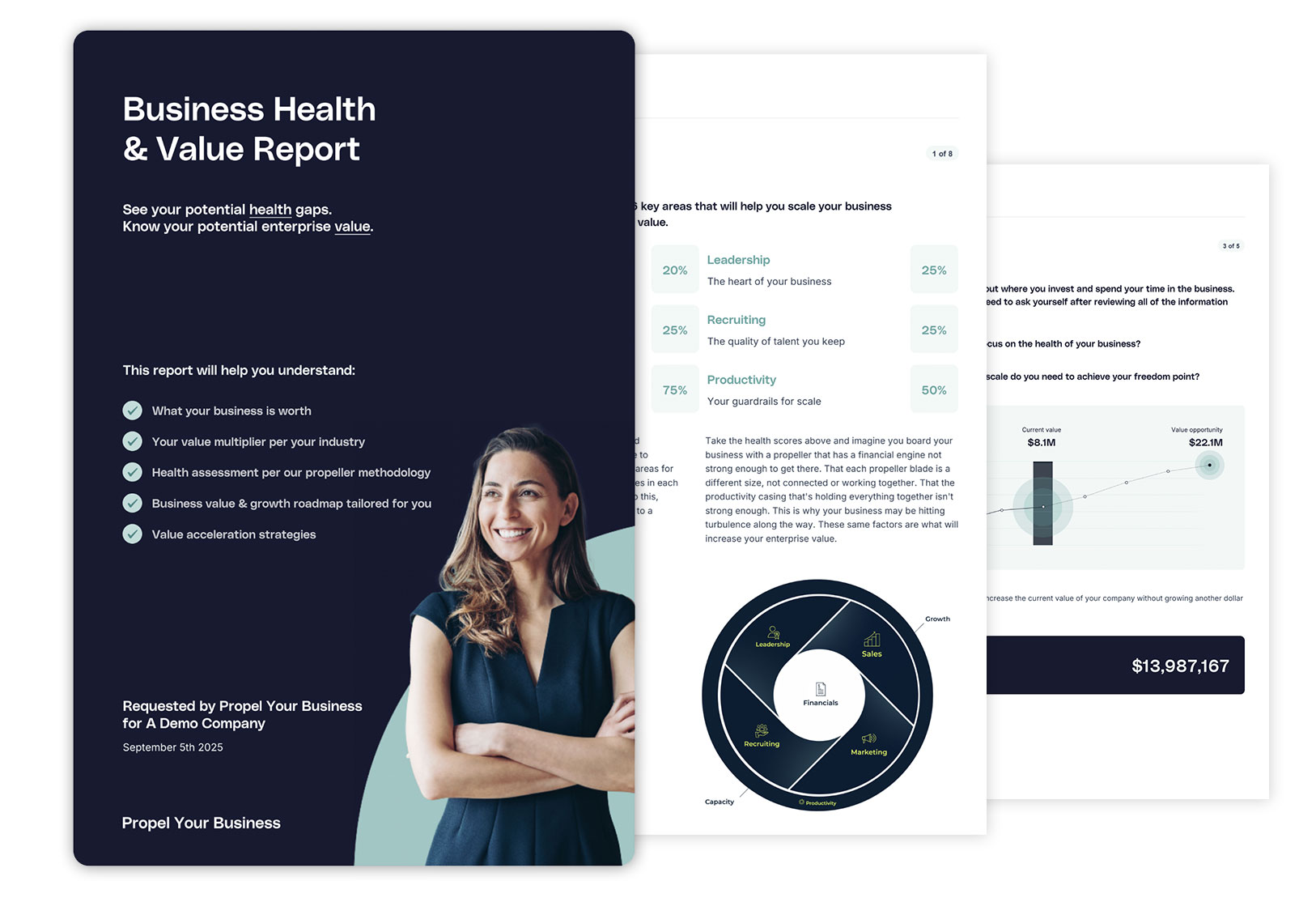
If you’re running on EOS and want to see how your business measures up, take the Health & Value Assessment to discover your exit readiness score.